
What if the hotel booking isn’t where the competition starts anymore?
For years, hotel and destination marketers have focused on winning the traveler who is ready to book. Get in front of them at the right moment, give them a reason to choose you, and make the path to conversion as easy as possible.
But what happens before that search?
A traveler might ask AI, “Where should I go for a long weekend in the Southeast?” or “What are the best hotels for a family beach trip?” They may not have a destination in mind yet, let alone a specific property. They’re still dreaming, researching, and narrowing down their options.
That early conversation can have a big impact on what happens next.
If AI helps create the shortlist, being included as an option suddenly matters a lot. A hotel or destination that gets recommended has a chance to inspire and make the next round of research. One that never shows up may not get considered at all.
For hospitality and destination marketers, that’s more than an AI search question. It’s a marketing and budget question: Are we investing enough in the part of the traveler journey where demand is created, not just where it’s captured?
Travel Discovery Is Moving Upstream
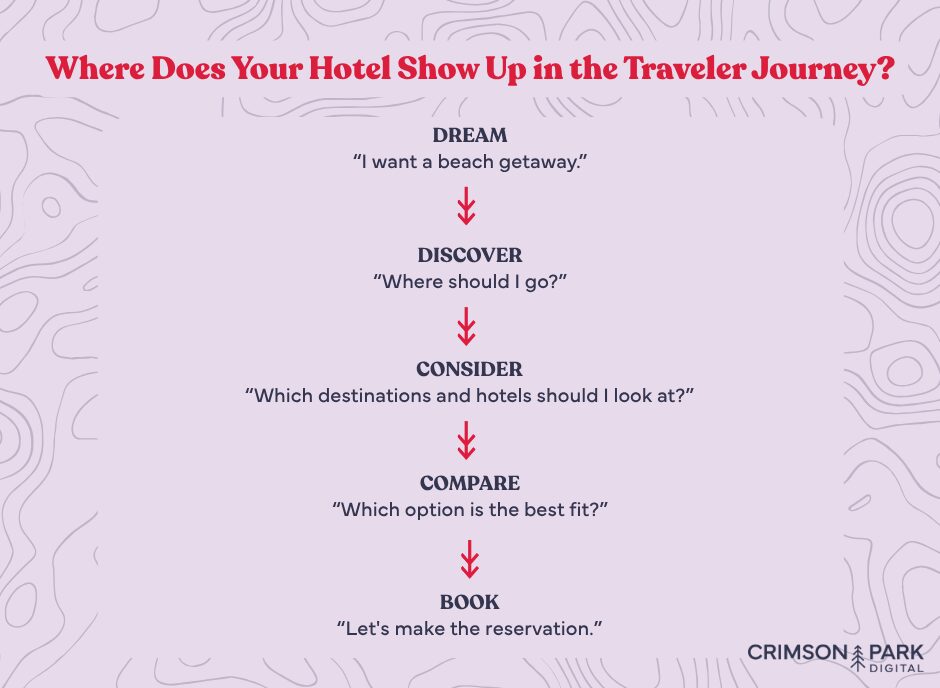
A traveler might start with a vague idea of taking a trip, research destinations, compare hotels, look at reviews, build an itinerary, and eventually make a reservation.
Marketing has traditionally focused heavily on the latter half of that journey because those travelers are easier to identify and connect to revenue. AI is making the earlier stages more important, though.
Consider the types of questions travelers can ask:
- What are some underrated places to visit in the Carolinas?
- What should I know before planning a trip to Charleston?
- What are the most popular things to do in Savannah this fall?
- Which hotels are good for a work trip but still close to things to do?
- What’s the best area to stay in Asheville for a first-time visitor?
- Are there any pet-friendly hotels near the beach?
Those questions aren’t necessarily about a specific hotel. They’re about figuring out what the trip should look like.
If AI helps narrow those options, the brands that appear in the answer have already gained an advantage.
This Is Also a Budget Conversation
That shift gets especially interesting when you look at the hospitality marketing budget.
Lower-funnel activity is easier to defend because the connection to revenue is often clear and attributable. A paid search campaign generates bookings. A booking page improves conversion. A retargeting campaign brings someone back to complete a reservation.
Upper-funnel activity is harder to tie directly to a transaction and, more often than not, doesn’t get enough budget or attention.
A traveler might discover a destination months before a trip. They could see a hotel mentioned in a travel article, encounter it in an AI recommendation, search for it directly later, and eventually book.
Which interaction gets credit?
Traditional attribution may give most of the credit to that final branded search or direct visit, even though earlier touchpoints helped get the traveler there.
That doesn’t mean hospitality brands should move their entire budget away from demand capture. Hotels still need bookings, and destinations still need visitors.
Instead, it may be time to look more closely at the balance between:
Demand capture: Reaching travelers who already know what they want and are close to booking.
Demand creation: Building awareness and consideration before a traveler has made that decision.
Both matter. The question is whether your current marketing mix gives the second enough attention.
Hotels Have More Opportunities Than They Think
Hotel marketing can get very focused on the property itself: rooms, rates, amenities, and location.
But travelers aren’t really buying a room. They’re buying the trip that room helps create.
A hotel may be particularly appealing for:
- A romantic weekend
- A family vacation
- A food-focused trip
- A business trip
- A beach getaway
- A major event
- A walkable city experience
Those associations create opportunities to become relevant before someone searches for the hotel’s name.
That also changes the content conversation. Instead of focusing only on bottom-funnel searches such as “hotels in [destination],” hospitality brands can think about the questions that happen before the booking decision.
What are travelers trying to figure out? What experiences are they planning? What makes one destination or property a better fit than another?
Those questions can uncover opportunities to build visibility across both traditional search and AI-driven discovery.
DMOs Have an Even Bigger Opportunity
Destination marketing organizations aren’t just competing for a hotel booking. They’re competing for the destination itself.
Travelers don’t always begin with a destination in mind. They might start with a trip idea. That is where destination storytelling can have a real impact.
A strong DMO strategy doesn’t just tell people that a destination is worth visiting. It helps travelers understand why that destination fits the trip they want to take.
As AI becomes more involved in those early questions, that context gives destinations more opportunities to enter the conversation before travelers have made up their minds.
AI Visibility Isn’t Just About Your Website
One of the biggest mistakes is treating AI search as another version of traditional SEO, where everything happens on your own site.
Your website is still incredibly important, but it is only one part of the picture.
AI systems can encounter information about hotels and destinations across a broader ecosystem, including:
- Travel publications
- Reviews and ratings
- Industry websites
- Local and regional publications
- Travel blogs and guides
- Social platforms
- Relevant directories
- Other trusted third-party sources
That makes your broader online presence increasingly important.
A hotel may have excellent content on its own website, but if the information travelers encounter elsewhere doesn’t reinforce what makes that property unique, there can be a disconnect.
Your brand story doesn’t stop at your homepage.
What Should Hospitality Marketers Be Asking?
There isn’t a magic checklist that guarantees a hotel or destination will appear in every AI recommendation. The right approach depends on the brand, market, audience, and competitive landscape.
But a few questions are worth bringing into the conversation:
Where are travelers discovering us? Look beyond bookings and website traffic to understand where people are forming opinions about your property or destination.
What questions come before the booking? The biggest opportunity may not be the keyword closest to conversion. It could be the question that leads someone toward your destination or property.
Are we visible beyond our own website? Consider the publications, reviews, guides, directories, social channels, and other sources shaping your online presence.
Does our budget reflect the entire traveler journey? If nearly all of the investment is focused on people who are already ready to book, there may be an opportunity to build more visibility earlier.
The Booking Still Matters. It Just Doesn’t Start There.
AI isn’t replacing hotel websites, booking engines, SEO, paid search, OTAs, or the other channels hospitality brands rely on to drive revenue.
What is changing is the path travelers take to get there.
The decision about where to go, where to stay, and what’s worth considering can happen well before someone is ready to make a reservation. If AI is helping shape those decisions, being visible during that earlier stage becomes a commercial opportunity, not simply another marketing metric.
For hotels, resorts, tourism brands, and DMOs, the question isn’t whether to choose upper-funnel or lower-funnel. It’s whether your strategy gives enough attention to both.

Crimson Park Digital helps hospitality and tourism brands connect the dots between SEO, content, AI search optimization, and broader digital strategy. If you’re ready to understand where your hotel or destination is showing up in AI search, where competitors are getting ahead, and where there may be opportunities to reach travelers earlier in the journey, let’s chat!


