
Tourism marketing has historically always had a fairly clear mission: attract visitors, drive bookings, and generate economic impact. These goals still matter. They always will.
But if you work in destination marketing, you’ve probably noticed something shifting over the last few years. The questions you’re being asked are changing.
It’s no longer just: “How many visitors did we bring in?”
Now it’s:
“How do residents feel about tourism?”
“How are we communicating tourism’s value to the community?”
“How do we support local businesses beyond listing them on our website?”
“How do we keep stakeholders informed and engaged?”
“How do we tell a destination story that resonates with both visitors and locals?”
Suddenly, marketing isn’t just about attracting travelers. It’s about managing relationships. And for many DMOs, that’s creating both new opportunities and new challenges.
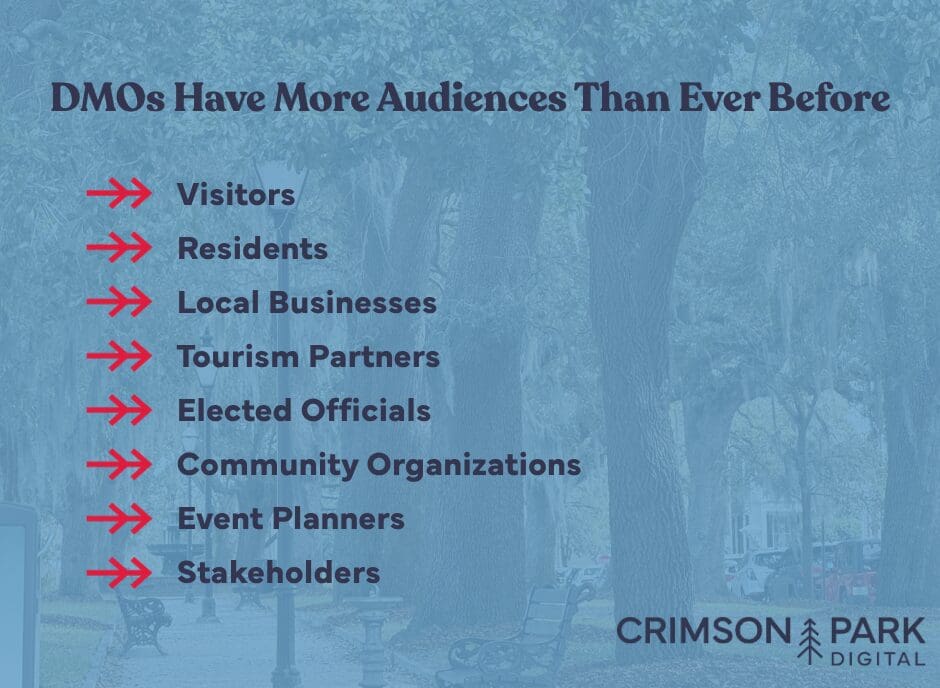
DMOs Have More Audiences Than Ever Before
Most destination marketing strategies were built around a single audience: visitors.
Your website inspired travel. Your social media showcased experiences. Your campaigns drove awareness and visitation. That approach still plays an important role.
Now, the challenge is that visitors are no longer the only audience your organization needs to reach. Today’s DMOs are communicating with:
- Residents
- Local businesses
- Tourism partners
- Community organizations
- Elected officials
- Board members
- Event organizers
- Industry stakeholders
- Visitors
Each audience has different priorities. Visitors want inspiration. Businesses want support and visibility. Community leaders want measurable outcomes. Residents want transparency. Stakeholders want to understand the impact tourism is having on the destination.
The reality is that one message doesn’t work for everyone.
Many DMOs are finding that their biggest communication challenge isn’t attracting visitors. It’s creating meaningful engagement across multiple audiences with limited time, resources, and bandwidth.
As TK Knight, Executive Director of Visit Charlotte & VP of Sales, CRVA, notes: “Today’s destination organizations have a broader responsibility than ever before. Success isn’t only measured by the visitors we welcome, but by the relationships we build with our local businesses, community partners and residents. When everyone understands the value tourism brings to our destination, we create a stronger, more connected community.”
You’re Being Asked to Do More With the Same Team
Here’s the part nobody talks about enough: the role of the DMO has expanded significantly, but the size of the marketing team often hasn’t.
Many destination organizations are being asked to manage visitor marketing, stakeholder communications, partner engagement, content creation, public relations, social media, website management, reporting, and tourism advocacy all under the same roof.
That’s a lot.
And while the responsibilities continue to grow, the expectation remains the same: deliver measurable results. This is why strategic communication matters more than ever.
The answer isn’t creating more content. It’s creating smarter content.
Content that serves multiple purposes. Content that speaks to different audiences. Content that helps your organization tell a larger story about tourism’s role in the community.
Residents Are No Longer a Secondary Audience
For years, resident communications often sat on the sidelines of tourism marketing. Today, that’s becoming much harder to ignore.
Residents are paying attention to how tourism affects their communities. They’re asking questions about growth, development, infrastructure, events, and quality of life. They’re also asking how tourism benefits the places they call home.
As a DMO, you have an opportunity to help answer those questions. Not through lengthy reports buried on your website. Through storytelling. Through content. Through consistent communication.
Tourism’s impact shouldn’t only be discussed at annual meetings or stakeholder presentations. It should be part of an ongoing conversation.
The destinations that are building the strongest community support are often the ones actively showing residents how tourism supports local businesses, jobs, events, attractions, and community investment.

Your Website Has Become More Than a Visitor Resource
Think about how destination websites were traditionally designed. Most were built to answer one question: “Why should I visit?”
That’s still important. But many destination websites are now expected to do much more.
They serve as:
- Resources for local businesses
- Information hubs for stakeholders
- Economic impact libraries
- Partner engagement platforms
- Community storytelling channels
- And yes, visitor inspiration tools
That’s a lot of responsibility for a single digital platform. The most effective destination websites today recognize that not every visitor to the site is planning a trip.
The strongest digital strategies account for all of them.
The Future of Destination Marketing Is About Building Trust
Tourism organizations have always been storytellers. What’s changing is who those stories are for.
The destinations gaining momentum today aren’t just promoting attractions and experiences. They’re communicating value, helping residents understand tourism’s impact, strengthening relationships with local businesses, keeping stakeholders informed, and creating alignment across their communities.
At its core, that work comes down to trust.
When people understand the role tourism plays in their destination, they’re more likely to support it. When stakeholders feel informed, they’re more likely to stay engaged. When local businesses feel connected to the destination’s vision, stronger partnerships follow.
Trust doesn’t happen overnight. But it starts with communication.
What This Means for Your DMO in 2026
If you’re feeling like destination marketing has become more complex, you’re not imagining it. The expectations placed on DMOs are evolving. You’re still responsible for attracting visitors. But you’re also being asked to communicate with residents, support local businesses, engage stakeholders, and demonstrate tourism’s value in new ways.
That’s a bigger job than many destination organizations were originally built for. The good news? It’s also an opportunity.
DMOs that embrace this shift can build stronger relationships, create more community alignment, and position themselves as valuable leaders within their destinations. Marketing will always matter.
But the future belongs to destination organizations that understand how to communicate with their entire community, not just their visitors.
At Crimson Park Digital, we help DMOs navigate that evolving landscape through strategic content marketing, organic search optimization, website optimization, audience segmentation, and destination storytelling. Whether you’re looking to strengthen stakeholder engagement, improve organic visibility, or create a more effective digital presence, our team helps destinations connect with the audiences that matter most.


