
Your organic traffic went up. Great! But did your visibility actually improve?
Those might sound like the same question, but they tell us two very different things.
A brand can appear in thousands of Google searches without getting a click. It can be cited in an AI answer without generating a website session, or have a social post reach thousands of people without sending a single visitor to the site. A local business can show up in Google Maps and generate a phone call without that person ever visiting the website.
None of those interactions necessarily show up in a traditional organic traffic report, even though each one represents an opportunity for someone to encounter the brand.
As the way people discover information continues to change, we started asking ourselves at CPD whether our reporting was actually capturing the full picture of organic visibility.
That question eventually led us to build something of our own: CPD’s Organic Visibility Score, an evolving framework designed to look at visibility across search, AI, social, local, website, and brand ecosystems.
It isn’t intended to replace traffic, rankings, or channel-level reporting. Instead, it gives us another layer of context for understanding how visible a brand actually is before, during, and beyond the website click.
The problem with treating website traffic as the whole story
Traffic is still one of the most useful, measured metrics in digital marketing. If people are reaching your website through organic search, that’s a signal that your content is getting attention and capturing demand.
The problem comes when we treat that number as a complete measurement of organic performance.
Consider what happens when someone searches Google for a question related to your industry. Your article appears on the results page, and the person sees your brand name while scanning the available answers. Maybe they don’t click because they found enough information in the search results. Maybe they bookmark the page and come back later. Maybe they simply remember your company and search for it directly a few weeks from now.
From a traffic report, the original search produced nothing.
From a visibility perspective, your brand was still part of that person’s discovery process.
AI search makes this even more obvious. Someone can ask ChatGPT, Google AI Overviews, Gemini, or another AI platform a question and encounter your company or content in the answer without ever clicking through to your website. The same thing happens on social media when someone sees your content, recognizes your name, and keeps scrolling.
Those interactions aren’t necessarily conversions, and we don’t want to pretend they are. But they are still part of the path between someone not knowing your brand and eventually considering it.
That’s the gap we wanted to measure.
We started with a simple question: What does “visibility” actually mean?
Before we built the score, we had to define what we were trying to measure.
For us, organic visibility isn’t limited to whether a website ranks for a keyword. It’s the broader presence a brand has across the digital places where its audience discovers information.
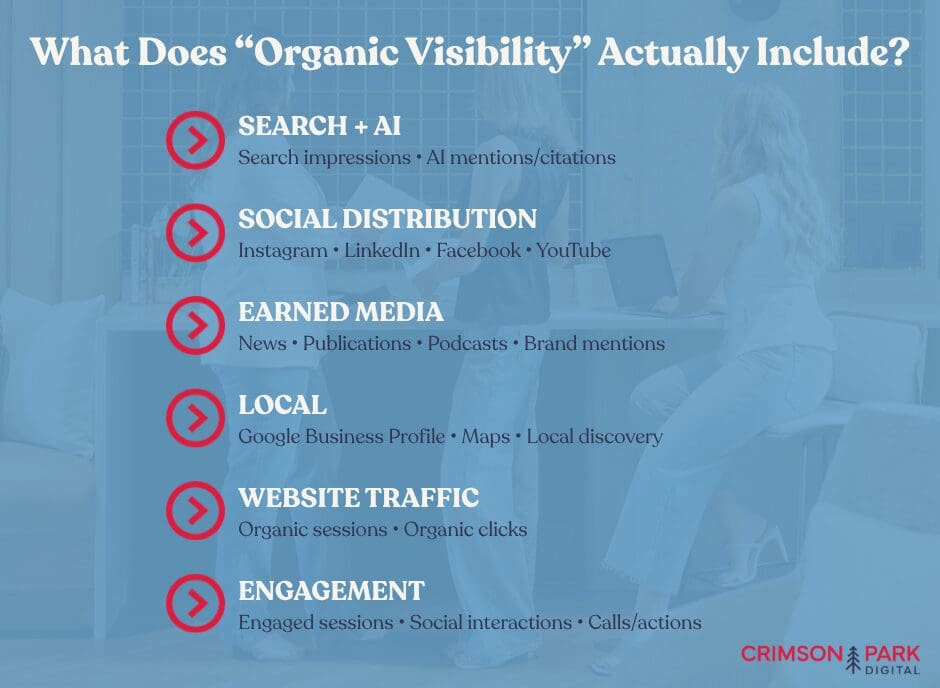
That includes traditional search, but it also includes AI-generated answers, social distribution, local search, third-party mentions, website visits, and engagement.
The framework we developed brings those signals together into one composite score. Each category is normalized to a common scale and weighted based on its role in the broader discovery journey.
We’re moving from “Did someone click?” toward a more complete question: “Was the brand visible where people were looking?”
Search and AI visibility became the foundation
We started with search and AI because these channels tell us something particularly important: whether a brand is appearing when people are actively looking for information.
Traditional search impressions remain an important part of that picture. They show how often a brand’s content has the opportunity to be seen in search results, even when someone doesn’t click.
AI visibility adds another layer. As more people use AI platforms to research questions, compare options, and find recommendations, being mentioned or cited in those answers can become an important part of brand discovery.
We also spent time thinking about branded versus non-branded search. Our conclusion was that we didn’t want to give branded search extra weight. Adding more weight to branded search could also give established brands an automatic advantage.
If a large, well-known company has thousands of people already searching its name every month, that doesn’t necessarily mean its organic content strategy is expanding its reach.
At CPD, a lot of our organic work is focused on building content ecosystems around educational topics, questions, and problems that lead people back to the brand. In other words, we’re often trying to reach the person who doesn’t know the brand yet.
That makes non-branded discovery especially valuable.
We want to know whether someone can search for a topic, find useful content, and discover the brand through that experience.
Then we looked beyond search
Content doesn’t live exclusively in search results anymore. A blog might be distributed through LinkedIn, Instagram, Facebook, YouTube, Pinterest, or other social platforms. Those channels can introduce the same ideas to people who may never encounter the original article through Google.
That’s why social distribution visibility became another part of the framework. How often is the brand’s content being put in front of people?
That matters because organic visibility increasingly comes from a combination of owned content and the platforms that help distribute it.
Local visibility needed its own category, too
The same logic applies to local search.
For a local business, someone may never visit the website before contacting the company. They might find the business through Google Maps, look at the Google Business Profile, check reviews, and call directly.
If we’re only looking at website sessions, we’ve completely missed that interaction. So we created a separate local visibility category to account for the local discovery data, including Google Business Profile, Apple Maps, Yelp, Google Maps, and other local platform visibility.
Earned media adds another layer of visibility
Earned media is another piece of the broader visibility ecosystem. Digital publications, news coverage, podcasts, magazines, and other third-party mentions can put a brand in front of entirely new audiences while creating additional opportunities for discovery.
It also gives us a useful way to think about visibility beyond channels a brand directly controls. A company can publish its own content, but when an industry publication references its expertise, a podcast features one of its leaders, or a news outlet mentions the brand, that exposure carries a different kind of value.
The broader goal is to create a framework that can account for the different ways a brand earns attention online, not just the places where it publishes content itself.
And yes, website traffic still matters
Website traffic is still an important part of the picture. It tells us whether visibility is translating into an actual visit, which is an important step in the customer journey.
Within the Organic Visibility Score, we look at metrics such as organic sessions and clicks from organic sources to understand how much of that visibility is turning into website traffic. This gives us a clearer view of demand capture without treating a website visit as the only sign that a brand is performing well.
That distinction is important because visibility and traffic measure different things. A brand can increase its search impressions, AI mentions, social reach, or local visibility without seeing the same increase in website sessions. That doesn’t automatically mean the strategy isn’t working. It may mean more people are encountering the brand earlier in the discovery process, before they’re ready to click.
Looking at both sides of that equation gives us more context around what is actually happening.
Engagement: What happens after people find you?
Visibility is only one part of the journey. Once someone encounters a brand, we also want to understand whether that visibility leads to interaction.
That’s where organic engagement comes in.
Depending on the channel, this can include engaged website sessions, social post interactions, or actions from local listings such as calls and direction requests.
These metrics help show what happens after someone sees the brand. A search impression tells us the brand appeared. A website session tells us someone clicked. An engaged session or social interaction tells us they did something with that content.
Together, these signals create a more complete picture of how visibility turns into interaction.
Why the score is weighted instead of treating every metric equally
Not every visibility signal means the same thing, so we don’t treat every metric as equal.
A Google Search impression represents a different type of exposure than an Instagram impression. An AI citation is different from a website session, and a Google Maps view serves a different purpose than a social interaction.
Our framework accounts for those differences by grouping related metrics into broader categories and assigning each category a weighted value.
Search and AI visibility carry the largest portion of the score because they capture opportunities to appear when people are actively looking for information. Social distribution and local visibility also play meaningful roles, while website traffic and engagement help us understand how that visibility translates into action.
The result is a score that gives us more context than simply adding up every impression or looking at traffic in isolation.
We also track Total Digital Reach
The Organic Visibility Score isn’t designed to answer every question, though.
We also wanted a simpler metric for understanding the overall scale of a brand’s digital exposure. That’s where Total Digital Reach comes in.
Total Digital Reach combines impressions and views across relevant digital channels. Depending on the client, that could include search impressions, social views, Reddit mentions, YouTube views, and local visibility metrics.
Unlike the Organic Visibility Score, Total Digital Reach isn’t weighted. It’s simply a way to see the total volume of digital exposure across the channels we’re measuring.
The two metrics work well together because they answer different questions.
Total Digital Reach shows the scale of exposure. The Organic Visibility Score provides more context around the breadth of that visibility.
What this means for organic reporting
The goal isn’t to replace the metrics marketers already use.
Rankings still matter. Traffic still matters. Clicks, conversions, engagement, and other channel-specific metrics still matter.
The problem is that none of them tells the entire story on its own.
A person might discover a brand through an AI answer, encounter its content on social media a few days later, find it again in Google Search, and eventually visit the website through a branded search.
Looking only at the final website visit would miss most of that journey. That’s where a broader visibility metric can add useful context.
Instead of asking only, “How much traffic did we generate?”, we can also ask:
- How often is the brand appearing in relevant search results?
- Is the brand showing up in AI-generated answers?
- How far is its content reaching across social platforms?
- Is it visible in local search?
- Is that visibility translating into website visits and engagement?
Those questions don’t replace performance reporting. They make it more useful.
The future of organic visibility is bigger than Google
The way people discover information isn’t getting simpler.
Search engines are still a major part of the journey, but they’re now joined by AI platforms, social networks, local search, online communities, publishers, and other digital channels.
That means organic visibility increasingly depends on more than where a website ranks.
Our Organic Visibility Score is our way of looking at that bigger picture. The idea behind it is simple: visibility happens before the click, and our measurement should account for it.
Traffic tells us who clicked. Rankings tell us where we appeared. But visibility helps us understand whether people are encountering the brand across the broader digital ecosystem in the first place.

At CPD, that’s the shift we’re paying attention to. If you’re ready to look beyond traffic and rankings and better understand how visible your brand really is across search, AI, social, local, and other digital channels, reach out to us today about building an organic strategy that measures the bigger picture, not just the click.


