
PR didn’t disappear. It just expanded into search.
Public relations used to feel a lot more linear. You write a press release or pitch, send it to relevant reporters and editors, hope it gets picked up, and maybe land a feature online or in a newspaper, magazine, or broadcast segment. If it worked, it created a moment of visibility. If it didn’t, it disappeared into the inbox void.
That version of PR still exists, but it no longer reflects how people discover brands. Today, visibility doesn’t start with a reporter.
It starts with a search bar, an AI prompt, a Reddit thread, a YouTube review, or a “best of” list that was never pitched directly but still shows up at the exact moment someone is deciding.
So the conversation is no longer really digital PR vs traditional PR. It’s about how PR fits into a search-first, AI-influenced discovery system where attention is fragmented, and decisions happen long before someone visits a brand’s website.
PR didn’t disappear. It expanded into search, AI, and everywhere else people look for answers.
Traditional PR: Still Valuable, But No Longer Enough on Its Own
Traditional PR still plays an important role in the ecosystem.
It’s built on relationships with journalists and editors, and when it works, it delivers credibility in a way few other channels can match. A feature in a respected publication or a strong broadcast mention still carries weight, especially for brand trust and reputation.
But it operates within clear limitations. It relies on editorial gatekeepers, it moves on longer timelines, and it tends to create isolated moments of attention rather than ongoing visibility.
You secure a placement, it goes live, and the impact is often difficult to measure beyond surface-level reach.
More importantly, traditional PR doesn’t always travel with the modern user journey. People are constantly searching, comparing, asking AI tools for recommendations, and reading third-party validation before they ever reach a brand-owned channel.
That shift is where digital PR starts to matter more.
Digital PR: Built for Search, AI, and Modern Discovery
Digital PR still involves storytelling and media outreach, but the environment it operates in is much wider.
Instead of focusing only on reporting and legacy outlets, it expands into:
- Online publications
- Industry blogs
- Creators and influencers
- Community platforms like Reddit
- Data-driven content campaigns
- High-authority niche sites
The goal is no longer just coverage. It is visibility across the digital ecosystem that actually shapes decisions.
Every mention becomes more than awareness. It becomes a signal. A signal that tells search engines and AI systems that a brand exists in a category, is being referenced by others, and is relevant enough to surface in answers.
That is a very different role from the one traditional PR ever played.
The Shift From Coverage to Visibility Systems
Traditional PR is campaign-based. Campaign thinking looks like this: we got featured in X publication.
Digital PR is system-based. Systematic thinking looks like this: where does our brand show up when someone searches, asks AI, or compares options?
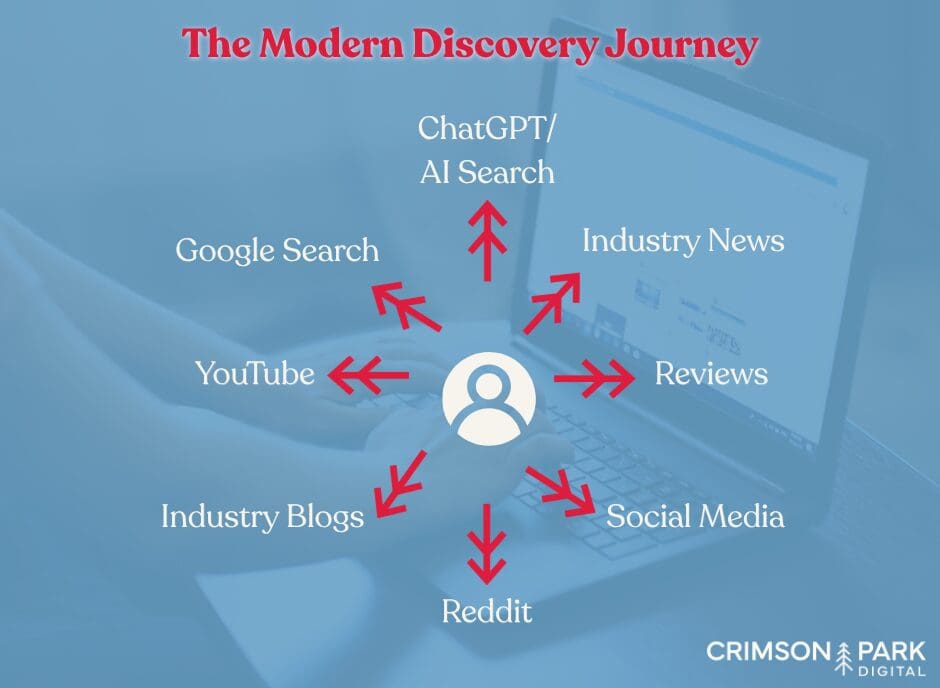
Because modern discovery doesn’t happen in one place anymore. It happens across:
- Search results
- AI-generated summaries
- Reddit threads
- YouTube videos
- Comparison blogs
- Review platforms
- “Top 10” listicles
If your brand only exists in one of those layers, its visibility is incomplete. Digital PR is what connects those layers together.
Why Digital PR Matters for SEO and AI Search
Search engines and AI tools are no longer just ranking websites. They are interpreting the entire web conversation around a brand.
That includes:
- Mentions across authoritative domains
- Contextual backlinks
- Brand associations across topics
- Content consistency across platforms
- External validation signals
Digital PR directly influences those inputs. Not by manipulating systems, but by increasing the amount of credible, relevant information that exists about a brand across the web.
This is what modern search systems rely on to decide what gets surfaced in results and AI answers. So digital PR is less about “press coverage” and more about the distribution of authority.
Authority Signals: The Invisible Layer of Visibility
Some brands consistently show up everywhere. Not because they publish more content, but because they have stronger authority signals across the internet.
Digital PR builds those signals through:
- Mentions in trusted publications
- Inclusion in industry roundups
- Contextual backlinks from relevant sources
- Repeated brand references across platforms
- Third-party validation inside high-authority content
Search engines and AI systems use these signals to determine trust and relevance. In AI-driven search especially, where answers are synthesized rather than ranked, these external signals often determine whether a brand is included at all.
If your brand only exists on your own website, you are relying entirely on self-reported authority. Digital PR changes that by making your brand part of the wider conversation already happening online.
Where Digital PR Has the Most Impact Today
Digital PR shows up most clearly in real-world discovery behavior.
Think about how people actually search now:
- “Best options for…”
- “Top providers near me…”
- “X vs Y comparison…”
- Reddit threads ranking above brand sites
- YouTube reviews influencing trust
- AI summaries pulling from multiple sources
In these moments, traditional PR coverage alone is not enough to influence visibility. Digital PR ensures the brand is present across the ecosystem, feeding those answers.
How CPD Thinks About Digital PR in a Visibility System
At CPD, digital PR is not treated as a standalone tactic. It sits inside a broader visibility system that includes:
- SEO + AI search optimization or GEO
- Content strategy
- Brand positioning
- Multi-channel distribution
- Authority building
The goal is not just to generate press. It is to ensure a brand is consistently present across the environments where discovery actually happens.
Search, AI tools, and third-party platforms are all part of that ecosystem. Visibility is no longer about a single ranking. It is about being part of the answer layer.
Digital PR Strategy for SEO, AI Search, and Modern Brand Visibility
Digital PR has become a foundational part of how brands are discovered across search engines, AI-generated answers, and third-party platforms.
For industries like healthcare, hospitality, and multi-location businesses, this shift is especially important because visibility is no longer controlled by a single channel. It is shaped by how consistently a brand appears across the broader digital ecosystem.

At CPD, we help brands connect digital PR, SEO and GEO into one unified visibility strategy designed for how people actually search today.
If your goal is to improve how your brand shows up across search, AI tools, and digital platforms, Crimson Park Digital can help build a visibility system that reflects how discovery actually works now.


