
Healthcare marketing has a reputation for being, well, boring. And honestly? Scroll through enough healthcare social media feeds, and it’s easy to see why.
There are plenty of health awareness graphics, holiday greetings, generic wellness tips, and announcements about the latest practice updates. That content isn’t necessarily wrong. Patients need helpful health information, and healthcare brands have a responsibility to share it accurately.
But when every practice is posting the same types of content, how is anyone supposed to stand out?
Healthcare brands aren’t just competing with other healthcare brands anymore. They’re competing with everything in someone’s feed. A funny video from their favorite creator. The new restaurant everyone is talking about. That one friend who somehow always has the perfect meme.
Your next social media post is competing for attention with all of it!
That doesn’t mean healthcare brands need to turn their feeds into comedy accounts. It means playing it safe all the time could be the very thing keeping your content from getting noticed.
The Problem With Playing It Safe
Healthcare is a serious business. People want to know their health is in good hands, and nobody wants their orthopedic practice, dental office, or specialty clinic making light of a serious medical concern.
Totally fair.
But there’s a difference between being professional and being predictable.
When every post follows the same formula, audiences start to tune out. A stock photo, a generic caption, and a reminder to schedule an appointment might check the box on your content calendar, but does it give someone a reason to stop scrolling?
Healthcare social media marketing needs more than a steady stream of informational posts. It needs content that makes people feel something, whether that’s curiosity, amusement, reassurance, or recognition.
Think about the last time you shared a post with a friend. Chances are, it wasn’t because the graphic had excellent branding and a perfectly optimized caption. It probably made you laugh, taught you something useful, or captured a feeling you couldn’t quite put into words.
That’s the kind of connection healthcare brands should aim for.
Your Audience Isn’t Just Thinking About Healthcare
Here’s the thing: Most people aren’t scrolling social media looking for a new healthcare provider.
They’re looking for entertainment, catching up with friends, following their interests, and occasionally falling into a rabbit hole about something they never knew they cared about.
Healthcare brands have to meet people where they are, not expect them to suddenly care about a generic health tip just because it appeared between two entertaining videos.
That means looking beyond what your practice wants to announce and considering what your audience actually wants to see.
A physical therapy practice could share a relatable post about the difference between how someone thinks they’ll move after sitting at a desk all day and how they actually move. A dermatology practice might join a timely conversation about a skincare trend while offering helpful context from its clinical team. A healthcare organization could introduce its staff through quick, personality-filled videos instead of relying entirely on formal team photos.
Each example still connects to healthcare. The difference is that the content gives people another reason to engage with the brand beyond needing an appointment.
And that matters because people are people before they’re patients.
Educational Content Still Matters. It Just Needs Some Personality.
Before you delete every health awareness post on your calendar, take a breath.
Educational content remains an important part of healthcare social media marketing. Patients need reliable information about symptoms, treatment options, preventive care, and when to seek professional help. Helpful content also gives healthcare organizations opportunities to demonstrate their expertise and build trust over time.
The goal isn’t to replace education with entertainment. It’s to make room for both.
Think of your content mix as a conversation rather than a never-ending lecture. Some posts answer important questions. Others introduce the people behind the practice. Some respond to timely conversations, while others simply make your audience smile.
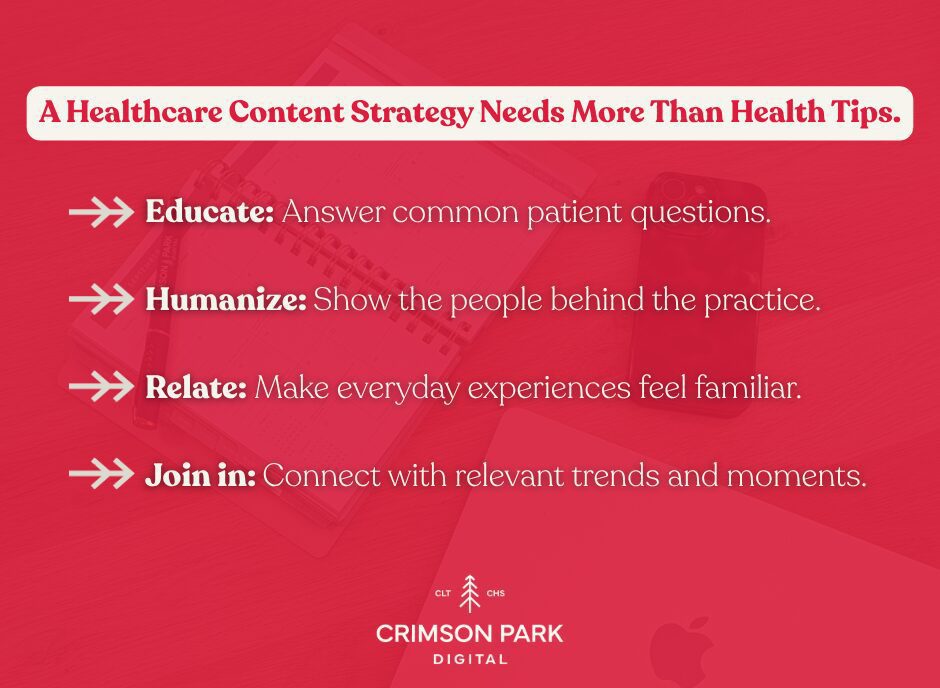
A balanced healthcare content strategy can include:
- Educational content: Answer common patient questions, explain procedures, and share practical health tips.
- Human content: Put providers, clinical teams, and staff personalities front and center. People connect with people, not just logos.
- Relatable content: Acknowledge everyday experiences your audience recognizes, using humor where it fits the topic and audience.
- Timely content: Join relevant seasonal conversations, cultural moments, or emerging trends when there’s a natural connection to your specialty.
- Community content: Celebrate local partnerships, patient milestones when appropriate, and the people and communities your organization serves.
You don’t need every category in every week. The right balance depends on your specialty, audience, brand personality, and business goals.
What matters is giving people different reasons to pay attention.
Can Healthcare Brands Actually Have Fun on Social Media?
Absolutely. The trick is knowing where to draw the line.
Healthcare marketing comes with real responsibilities. Patient privacy, clinical accuracy, professional standards, and platform-specific considerations all matter. A trend that works for a fashion brand might feel completely wrong for a medical practice, and a joke about a serious condition could damage trust faster than a hundred polished graphics could build it.
So, no, not every trending audio deserves a place on your content calendar.
Instead, look for opportunities that feel natural to your brand. Could a provider explain a common misconception in a more conversational way? Could your team show a little personality in a short video? Is there a timely topic your audience is already discussing that your clinical experts can add something useful to?
The strongest ideas connect creativity with credibility.
And remember, being relatable doesn’t mean being unprofessional. A warm, funny, approachable brand can still communicate expertise. In fact, showing the human side of healthcare can help make a practice feel more approachable before someone ever walks through the door.
Just keep the humor focused on everyday experiences, not patient vulnerability. Never sacrifice accuracy or privacy for a trend, and make sure every post still feels like it belongs to your brand.
Stop Posting Just to Fill the Calendar
Here’s another uncomfortable truth: Consistency alone won’t fix a content strategy that isn’t connecting.
Posting regularly is important, but publishing three nearly identical graphics every week won’t automatically make your brand more memorable. Your content needs a purpose beyond keeping the feed active.
Start by looking at what your audience actually responds to. Which posts spark conversations, earn shares, attract meaningful comments, or bring new people to your profiles? Are certain formats getting more attention than others? Do people engage more when providers appear on camera or when posts address a familiar everyday frustration?
Use those signals to guide your next round of content.
Also, don’t judge every post by likes alone. Saves, shares, comments, profile visits, website traffic, and other meaningful actions can tell you different things about how your content performs. A funny post might introduce someone to your brand, while an educational post might help them feel more confident about contacting your practice later.
Both have a role to play.
This is where a thoughtful healthcare content strategy makes a difference. It connects creative ideas to audience needs, brand positioning, and measurable goals rather than chasing engagement for engagement’s sake.
And that takes more than jumping on whatever trend happens to be popular this week.
Safe Doesn’t Have to Mean Boring
Healthcare brands don’t need to abandon educational content, sacrifice professionalism, or become the internet’s next comedy sensation.
They do need to give people a reason to notice them.
In a crowded digital world, familiar formats and generic messaging can make even valuable information easy to overlook. A little personality, a more human approach, and content that reflects how people actually live can help healthcare brands build stronger connections with their audiences.
The opportunity is to make your expertise more approachable, your brand more recognizable, and your content more worth someone’s time.

At Crimson Park Digital, we help healthcare brands build digital marketing strategies that balance education, creativity, and measurable business goals. If your content calendar feels a little too predictable, let’s talk about how to make your healthcare brand stand out.


